The 4 Feasibility Check Questions in B2B Fiber: How to Transform Technical Feasibility into a Commercial Advantage
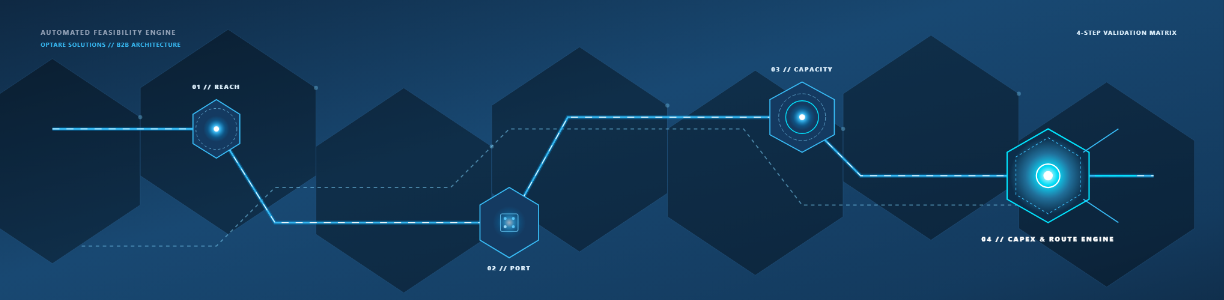
When a sales team presents a B2B connectivity proposal to a corporate client—whether it is a last-mile connection or a dedicated P2P link—the offer rests on an implicit premise: that someone, in some system, has validated the technical and financial feasibility of the project. For that proposal to be profitable and executable, there are four key questions that the international market has consolidated as the standard feasibility framework.
1. Is There Connectivity?
This is the fundamental starting point. Determining whether coverage exists involves crossing not only the map of one’s own network, but also, in an increasingly critical way, reusable third-party infrastructure (conduits, poles, and ducts). Identifying the actual physical proximity from the existing network to the customer location is the first essential filter to avoid blindly quoting deployments or assuming unnecessary civil works costs.
2. Are There Free Resources to Deliver the Service?
Reaching the customer is not enough: it is necessary to confirm that free resources exist to provide the service. In residential connectivity, this usually comes down to finding a free port in the terminal box. In a B2B dedicated link, the verification is more demanding: it requires verifying that there are available fibers in all sections of the circuit, and not just in the last mile, in addition to port and space in the equipment of the node where the service is delivered.
The operational challenge lies not only in having the data, but in querying it automatically and integrated within the commercial flow, without relying on case-by-case manual verifications.
3. Is There Capacity in the Transport Network?
Evaluating whether the route supports the committed traffic requires visibility over the transport network. At this point, a frequent reality in the sector arises: distrust in the accuracy of one’s own network inventory. Addressing this challenge does not require postponing digital transformation until a perfect inventory is achieved. Pre-sales automation can be structured progressively, allowing the operator to streamline the calculation of routes and deployment costs in a first phase, and incorporate capacity control as it consolidates its data governance.
4. What is the Route and Real Cost if Construction is Needed?
When the above conditions require network extension, the engineering department must calculate the physical route and its associated cost: meters of civil works, pole lines, land occupancy, and third-party access fees. Historically, this block represents the real bottleneck in terms of time and the main source of CAPEX deviation. Resolving it with engineering precision but at machine speed is what distinguishes a competitive commercial proposal from a subjective estimate.
The Balance Between Technical Rigor and Commercial Speed
Each of these questions resolved with delay or inaccuracy has a direct consequence on the bottom line: extended sales cycles, proposals that must be renegotiated due to underestimated costs, or the direct loss of the opportunity to more agile competitors.
The gap between engineering design capabilities and the commercial department’s expectations of immediacy is not resolved by reducing technical rigor, but by equipping teams with tools capable of applying network design rules automatically.
In a market where agility makes all the difference, the underlying question for operations and sales teams is not only whether your organization can answer these four questions, but how many engineering days and hours it currently takes to do so, and how many opportunities are lost along the way due to response time.