Insights from Telco Talent: Three Key Lessons from Physical Infrastructure Applied to the Digital World
Often, the word “infrastructure” evokes images of concrete, miles of high-speed rail tracks, or imposing airport terminals. However, in the telecommunications sector, the foundations supporting our connectivity also entail critical complexity and, above all, a deeply human component.
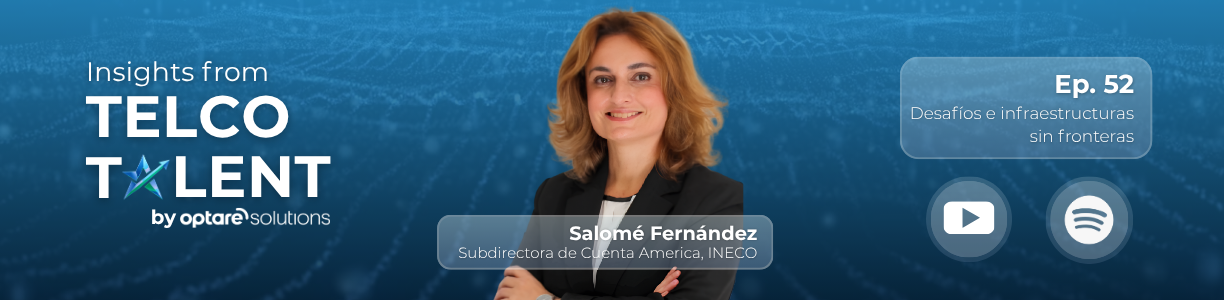
In the latest episode of our podcast Telco Talent, we had the opportunity to speak with Salomé Fernández Villar, Deputy Director of the America Account at INECO. Drawing from her experience in international megaprojects such as the Mecca-Medina High-Speed Rail or the expansion of the Jorge Chávez International Airport in Lima, Salomé shared insights that resonate deeply with our sector’s day-to-day work and with how we approach challenges at Optare Solutions.
Here are three key lessons from civil engineering that we can (and should) extrapolate to the development of Telco projects:
1. The “ideal” technical solution requires local adaptation
When approaching international-scale projects, it is tempting to replicate technological formulas that have already proven effective in other environments. Against this inertia, Salomé highlights the uniqueness of each challenge: «Sometimes we do not implement the technical solution that might seem ideal a priori, but rather the one that becomes ideal for that specific moment and context».
This premise is a constant for those of us integrating technology across diverse markets. Deploying a platform or automating an operator’s processes goes far beyond a simple technical transfer. It demands complete immersion in legacy systems, the client’s organizational culture, and their regulatory framework. At Optare Solutions, we are clear about this: technological excellence is only achieved when the solution generates consensus and organically integrates into the destination ecosystem.
2. Designing for the “enjoyment phase”: long-term operations
It is common for more technical profiles to have a preference for the design and construction phases. However, Salomé brings us back to the reality of the ultimate purpose of any project: «What we expect is for the longest phase to be the operation, maintenance, and exploitation of the infrastructure».
In Telco software and network development, this idea is the exact equivalent of our solutions’ lifecycle. A sophisticated network architecture or an agile deployment loses all its value if the resulting system turns out to be unmanageable or creates operational friction. Therefore, the focus of every project must be oriented toward ensuring that digital infrastructure is not only built on solid ground, but remains sustainable, efficient, and manageable over time for the teams responsible for day-to-day operations.
3. The biggest risk of a technical project: “Human vanities”
One of the most insightful contributions from the talk was her diagnosis of why highly capable teams sometimes fail: «What causes a team made up of the best, most trained, and most experienced people to fail to reach its full potential? Human vanities […] and not communicating in time».
In a sector characterized by a frantic pace of innovation, technical rigor is often taken for granted. However, it is interpersonal skills that truly determine the success or failure of a project. Cultivating a cohesive team where fluid communication, collaboration, and mutual commitment prevail will always offer better guarantees than relying on brilliant individual talents who are unable to work as a network.
At the end of the day, infrastructures—whether built with concrete or through lines of code—share a fundamental purpose: connecting people. And, as Salomé concludes, to make a qualitative leap in our careers and projects, the first step is daring to “fill the pool” through our own initiative.